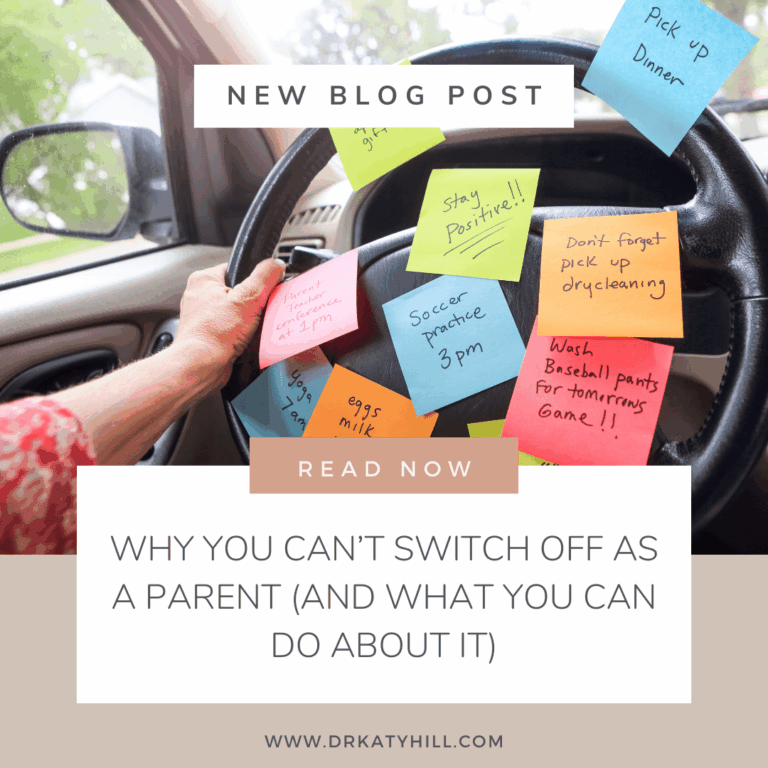
You might be sitting down, finally, at the end of the day – the kids are in bed, the kitchen’s clean enough, and there’s nothing urgently demanding your attention. But your mind? Still racing. You’re running through tomorrow’s logistics, replaying that difficult moment from earlier, wondering whether you remembered to reply to the school email.
Your body isn’t far behind. You might notice a low buzz of tension in your chest or jaw. Shoulders hunched. Breath shallow. And when you eventually get to bed, sleep escapes you so you pick up your phone and scroll aimlessly. You’re tired but wired.
This is a state I see all the time in my work with parents: thoughtful, loving, deeply invested people who struggle to power down. Not because they don’t value rest, but because their whole system has forgotten what rest actually feels like.
In this blog, we’ll explore why so many parents feel constantly ‘on’ and what small but meaningful steps might help you soften and power down a little.
the brain after baby
Becoming a parent changes your brain. Neuroplasticity is at its peak in the postnatal period, reshaping the brain to orient more closely toward the needs and safety of our children. Our attention becomes hyper-focused on attunement, protection, and responsiveness. That heightened sensitivity is natural and essential to caregiving.
But when there’s no space for recalibration, it can quietly become the baseline. Many parents find themselves constantly scanning, planning, anticipating even when things are calm. Their minds are still wired for alertness. Their bodies, still braced for action.
understanding your nervous system
It can be helpful to understanding what’s going on here in the body; specifically in the autonomic nervous system (ANS).
The ANS has two key branches: the sympathetic nervous system, which acts like an accelerator mobilising us to respond, act, and stay alert and the parasympathetic nervous system, which functions like a brake, helping us rest, digest, and connect.
Ideally, we’d move fluidly between these states. But many parents I work with find themselves stuck with the accelerator pressed down, rarely accessing the brake.
When the sympathetic system is chronically activated, it can look like having difficulty relaxing, falling or staying asleep. You can feel like you’re constantly switching tabs in your mind or feeling a background hum of irritability or tension.
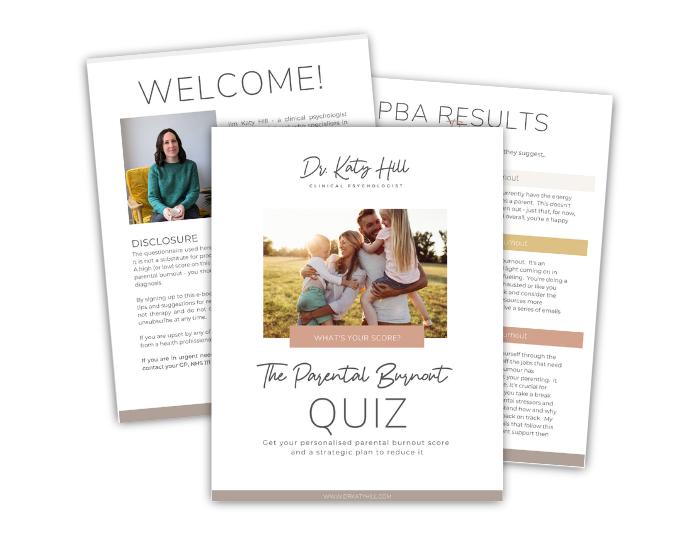
The Parental Burnout Quiz
Curious what your own parental burnout score is? Download the free assessment and get your score – plus expert tips on how to reduce it.
cultural pressures keeping you 'on'
Our environment reinforces this overactivation. We live in a world where we can check emails at midnight, read distressing news before we’ve brushed our teeth, and compare ourselves to thousands of other parents at the scroll of a thumb.
Because we can always be ‘on’, it can feel like we should always be ‘on’.
There’s a cultural narrative that tells us to be ever-productive, ever-responsive, and ever-available; especially in parenting. ‘Good’ parents, we’re told, are endlessly present and emotionally attuned. It’s easy to internalise the idea that anything less is neglect.
This doesn’t just create guilt around slowing down. It creates a persistent unease; the sense that if we do switch off, something will slip through the cracks. And it will be our fault.
REst isn't always easily available
For many families, the barriers to rest aren’t just internalised expectations; they’re logistical realities. Some children need more scaffolding, more co-regulation, more presence. If your child is in a more dependent phase of development, is neurodivergent or has complex health needs, vigilance isn’t optional – it’s what keeps things afloat.
Likewise, if you’re parenting solo there may not be another adult to tag in. You’re carrying the full load of decision-making, emotional labour, and care. It’s not surprising that your system struggles to switch off. There is no one else to hold the load, even temporarily.
So when we talk about rest, we have to do so with realism about what’s doable. Thankfully rest doesn’t have to look like a silent weekend retreat. For most parents, it’s about finding brief moments of recalibration in the midst of an already demanding day.
rest can feel unsafe
Many parents tell me they technically could rest but something in them won’t allow it. They scroll. They clean. They organise. They hover in motion, even when the house is quiet.
This is where it can be helpful to shift the question from “Why can’t I switch off?” to “When did switching off stop feeling safe?”
For many, this trace back decades. Perhaps busyness and achievement was prioritised and reinforced at home and/or at school. Or maybe there was trauma, loss or unpredictable circumstances that meant your system learned it had to be on high alert. You might feel uneasy and uncomfortable with rest because it doesn’t feel safe in your body.
the cost of chronic overdrive
When we live in a state of chronic sympathetic activation, we’re more prone to physical illness and ailments – migraines, stomach issues, chronic pain etc which makes life harder. But, most upsetting for my therapy clients, it also affects our ability to be the type of parent we want to be.
Being stuck in sympathetic nervous system activation makes it pretty impossible to be patient, empathic, flexible, to regulate our emotions or support our children in regulating theirs. These are all qualities we can access when our parasympathetic nervous system is active.
Parents often tell me they don’t feel like themselves anymore. They used to be funnier. Softer. More engaged. Now, they feel braced; as if parenting has become something they survive, not something they get to feel connected within.
what helps?
You don’t need a silent retreat or an elaborate routine. You need brief, regular invitations back into your body. Back into that parasympathetic space. Out of fight/flight and into rest/digest. Here are a few ways to begin:
Name what’s happening.
Rather than spiral into “Why can’t I relax?” try gently naming: “My system is still in go-mode.” This helps shift the frame from personal inadequacy to physiological reality; a crucial reframe that makes self-compassion possible.
Notice the scanning.
That subtle mental hum of planning, preparing, checking etc. is often a sign that your body still feels under threat. When you catch it, try anchoring into sensation: press your feet into the floor, place a hand on your heart or belly, or take a deep breath.
Let the exhale be longer.
One of the quickest ways to activate the parasympathetic nervous system is through your breath; specifically, extending your exhale. Try inhaling for four counts, exhaling for six. Let your outbreath be slow, audible if needed.
Create micro-moments of downshift.
Parents don’t have huge chunks of time but you don’t need them to recalibrate, take the small moments of ‘time confetti’ you have. A few slow breaths before school pickup. Resting your eyes while your child plays. Letting your shoulders drop while you wait for the kettle. It all adds up.
Practice, not perfection.
Some days it’ll come easily. Others, your system will resist. That’s ok. Take your time, you’re rebuilding your relationship to rest and practicing skills that take time to embed.
you're allowed to rest
Rest isn’t a luxury. It’s a biological imperative. There’s a reason you see lions lounging for hours in the wild – unburdened by the sociocultural pressures we humans face, their bodies intuitively conserve energy when they can.
You need that too. Parenting is profoundly energy-intensive. If you want to show up with patience, presence, and playfulness, you’ll need to recharge; not once in a while, but regularly and often.
And remember: our children are watching. Every time we acknowledge and respond to our own needs, we’re teaching them that self-care and self-advocacy matter. We’re helping them internalise a different message; that rest is not something to be earned, and that they don’t have to prove their worth through constant doing.
need more help managing stress?
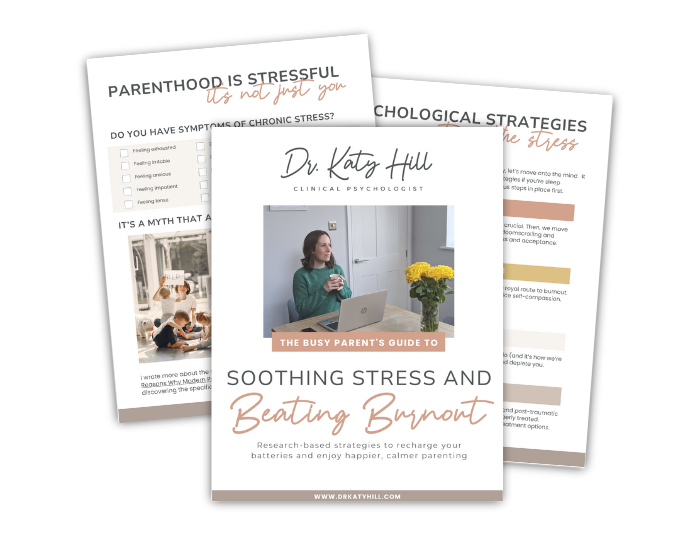
If you’re looking for more support, check out my free eBook, The Busy Parent’s Guide to Soothing Stress and Beating Burnout. It’s full of practical, evidence-based strategies to help you navigate the challenges of parenting with less stress and more balance.