
We all expect parenting to be tiring in the early years but many of us are surprised by how depleting parenthood remains, long after the nappies are gone. I see exhausted parents all the time in my clinical practice. They rarely come in complaining about exhaustion though.
What brings them in is how they feel about how they’re parenting when tired. They’re irritable, checked out and less fun than they want to be. More than anything, they feel a lot of shame about how they’re parenting.
That shame is part of what makes exhaustion so difficult to overcome. Many parents try to push through it or blame themselves for not being able to. Both responses tend to backfire.
In this blog, I want to offer a different perspective. Exhaustion is not a personal failing; it’s a problem of capacity. And taking that perspective allows you to understand it and work with more effectively.
Whether your exhaustion is temporary or long-standing, this blog will give you some realistic, compassionate ways to care for your children (and yourself) when you’ve not got much left in the tank.
tired vs exhausted - what's the difference?
We all get tired. A broken night’s sleep, a bug working its way through the house, an unusually busy week – tiredness is part and parcel of parenthood. But exhaustion is something different. It’s not a passing state; it’s a persistent depletion that sleep alone doesn’t fix.
When you’re exhausted, you might find that everyday parenting tasks – getting everyone dressed, planning meals, managing meltdowns – feel overwhelming or even insurmountable. You might find yourself snapping more than you’d like to, or numbing out with your phone, or dreading simple interactions that you would normally take in your stride.
And the guilt that follows – “Why am I so grumpy?”, “Why don’t I feel like playing?”, “Am I failing my child?” – often results in self-judgmental spirals which only makes things harder. It uses up the little energy you have with means you have even less energy left to regulate yourself and parent in the way you intend. You’re a human being, not a machine.
is this just a hard week or something deeper?
One of the first things I encourage clients to do is zoom out a little. Has this exhaustion built up slowly over time, or is it tied to something temporary like a sleepless baby, family illness, or a crunch period at work?
If it’s short-term, your only job might be to lower the bar. A few days of extra screen time, beans on toast for dinner, or skipping after-school clubs won’t undo years of loving parenting. In the bigger picture, it’s just a short season.
But if the fog has lingered for weeks or months, it’s worth digging deeper. Longstanding exhaustion needs more than a good night’s sleep. It’s important to check with your GP for medical causes like anaemia, thyroid issues, or sleep disorders – many of which are easily missed in busy parents.
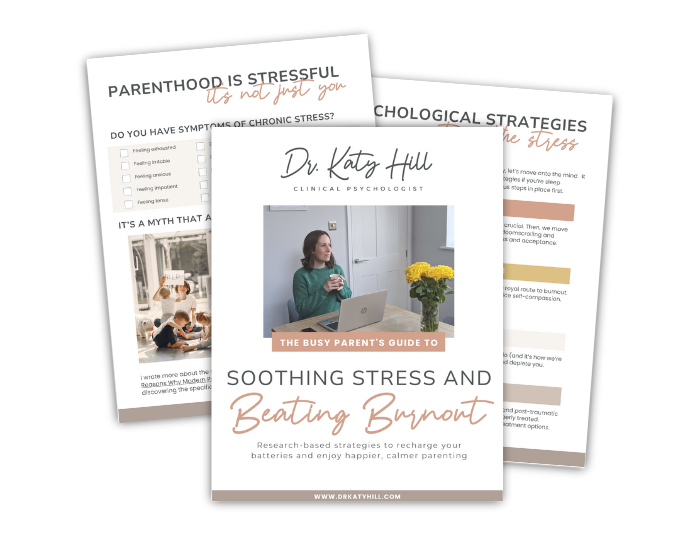
It’s also worth considering psychological factors. Chronic stress, anxiety, low mood, grief, and especially parental burnout can all be drivers of persistent fatigue. I’ve written more about the difference between tiredness and parental burnout here.

The Parental Burnout Quiz
Curious what your own parental burnout score is? Download the free assessment and get your score – plus expert tips on how to reduce it.
what do exhausted parents actually need?
Whatever the cause of your depletion, the two most common responses I see in parents (pushing on and self-criticism or self-attacking) are the least helpful. What parents need is something different. I encourage parents to get curious about what unmet needs they have and to respond to themselves with compassion rather than more pressure.
That might sound obvious, but it can be incredibly hard to do especially if you’re someone who holds high standards, who prides themselves on being capable, or who’s deeply committed to being a “good” parent. You may worry that if you lower the bar, things will fall apart. That you’ll become someone you don’t recognise. That you’ll let your child down.
But the truth is that your capacity is finite. When your tank is empty, pushing harder won’t magically increase your energy and it won’t make you a better parent. It will drive you closer to burnout. At some point, your body will rebel and you may find yourself unable to even get out of bed. You need to give yourself permission to be human, to soften and learn to work with the energy you do have, rather than trying to charge ahead with the energy you wish you had.
How parent well (even when you're exhausted)
Ok, so now we’ve established that pushing on regardless isn’t helpful; let’s talk about what you can do instead. Parents often ask me how can they be the parent they most want to be when they’re so exhausted and these are steps that I think are most helpful:
1. Get Clear on What Matters Most
In times of low capacity, it helps to return to your core parenting values. What qualities do you want to bring to your relationship with your children? What do you hope they feel when they think of you? Perhaps it’s warmth, safety, presence, patience, humour.
Now ask yourself: what is the smallest possible way I could embody one of those values today? What’s realistic for now?
Maybe you hold a value of ‘togetherness’ but don’t have the energy to take your children for a day out this weekend but you can find other low energy ways of expressing your value of togetherness. Maybe you can play catch in the backyard for 10 mins and chat about how school’s going for them at the moment. Or you can snuggle up on the sofa and watch a family film, or look through old photos together.
2. Lower Your Standards
This is not the time for elaborate routines, homemade snacks, or keeping up with every activity. Your job is not to provide a Pinterest-worthy childhood. Your job is to stay emotionally available and responsive enough – not all the time, not perfectly, but reliably, over the long term.
It’s (more than) OK to hand over the remote and let Bluey parent for a while so you can close your eyes and listen to a podcast to recharge yourself in the course of a busy day of parenting.
3. Connect in Low-Energy Ways
Connection doesn’t have to be high energy or high effort. In fact, many children love when things slow down. We forget that they can often be tired from nursery or school and activities too. Some children are more naturally introverted and absolutely thrive when things are more low key.
We don’t need to be constantly providing exciting or enriching activities for our children we can lie on the sofa while they play on the floor, cuddle and read books together, do colouring books side by side or watch TV together.
4. Talk About What’s Happening
If your child is old enough to understand, it can be helpful to name what’s going on in a developmentally appropriate way.
You might say something like “My body’s feeling really tired today. I’m going to rest here while you play.” or “I’m feeling really tired and grumpy today, I don’t want to play dolls but I’m happy to do some colouring or a jigsaw together”.
This kind of transparency builds trust. It helps children understand that you can have needs and still love and care for them deeply. It also models emotional awareness and boundary-setting; skills they’ll need in their own lives.
5. Model Rest and Self-Kindness
It’s really important to let them see you rest. Let them hear you speak kindly to yourself. When you say, “I’m tired, and that’s OK. I’m going to rest now so I can feel better later,” you’re teaching them something powerful. You’re showing them that rest isn’t laziness. That people are allowed to be human and it’s good to care for yourself as well as others. Imagine how different your relationship to rest might be if you’d had the privilege of having that modelled to you growing up.
Need more help with this?
Exhaustion, especially when it persists, is not something you have to manage alone. If you’ve been in this place for a while, or if you’re noticing signs of burnout (emotional numbness, ongoing irritability, feeling like a shell of the parent you want to be) you deserve support.
I work with parents in therapy to explore what’s draining them, make sense of their emotions, and begin to rebuild capacity with compassion. It’s not about fixing you, because you’re not broken, but about helping you feel more like you again.
If you’d like to talk about whether therapy might be helpful, you can find out more about I how work here and book a free 15-minute intro call here.