Like any parent, you want to give your child the best start in life. You don’t want to ‘wing it’ so you do what most thoughtful and intentional parents do these days – you put the work in. You’ve read the blogs (like mine!), bought the books, listened to the podcasts, and followed all the Instagram parenting accounts. You’re trying so hard to be a great parent and yet, you never feel like you’re doing enough.
All the information you’ve learned seems to have increased your anxiety rather than lessened it. You lie awake at night wondering whether you’re enriching them enough or overscheduling them. Whether you’re being a good gentle parent, or a permissive one. Whether the time you lost your temper damaged your attachment bond and set them up for mental health problems in the future.
If that resonates, I want to gently suggest something you might not have considered yet: you might be experiencing parental perfectionism.
It’s something I see in many of my clients but it’s not something they’ve noticed themselves. Many of us have erroneous ideas of what perfectionism looks like and it can be hard to spot in our increasingly perfectionistic culture (research shows rates have increased 30% since the early 1980s).
You might not feel like you’re perfect but if you’re constantly striving to be a better parent and you’re terrified of making mistakes, read on. Because there might be perfectionism fuelling your stress, guilt and exhaustion. Let’s unpack what it is, where it comes from, and why it matters.
And in next week’s blog, we’ll discuss what you can do to lessen its grip on you.
what is parental perfectionism?
When we think about what a perfectionist looks like we often imagine someone immaculately groomed and dressed, a former straight A student with colour-coded calendars and a spotless home. But perfectionism isn’t about what you’ve achieved, it’s not about looking or feeling perfect. It’s about feeling like nothing you do is ever quite enough.
In parenting, that can look like:
- Constant self-doubt and second-guessing your choices
- Feeling like mistakes are unacceptable; even tiny ones
- Setting impossibly high standards for yourself (and sometimes your children)
- Believing you need to ‘get it right’ all the time to be a good parent
- Struggling to relax or enjoy parenting because you’re always evaluating yourself
Parental perfectionism often hides behind love and care. You’re trying your best because you love your children and want the best for them but love gets tangled up with pressure, parenting becomes less about connection and more about performance.
And that’s exhausting.
Where does parental perfectionism come from?
Most perfectionist parents I work with aren’t trying to show off or be better than others; they’re trying to protect what matters most: their children. Perfectionism exists as a strategy to protect their children, the underlying thought process is something like ‘If I can get their childhoods ‘right’ then they’ll be happy and healthy and won’t suffer’.
Parental perfectionism is about keeping our children safe. But it can also be a long-standing strategy that we used since childhood to keep ourselves safe – safe from criticism from family members, peers, teachers or employers.
And we’re not just carrying our personal histories – we’re parenting in a cultural context that ramps up the pressure. One of those forces is the increase in perfectionism across the population, Curran & Hill (2019) noted that rates have increased by 33% since 1989. We’re all living, at least in the West, in increasingly individualistic, achievement focused and competitive societies.
That influence has trickled into the parenting culture, most of us are being influenced by a dominant culture force labelled by sociologist Sharon Hays as ‘intensive parenting’ – namely the belief that to be a good parent, you must:
- Constantly stimulate and educate your child
- Prioritise their needs over your own at all times
- Be emotionally available, responsive, and regulated 24/7
- Keep them safe from every possible harm (including boredom)
- Raise them into successful, happy, emotionally secure adults; with no missteps along the way
It’s an impossible standard and one that isn’t even that good for children if they feel increased pressure to be perfect themselves, but it’s everywhere; especially in online spaces.
Intensive parenting pressures are increasing at a time where our resources are diminishing (less village support, more economic stress, etc) no wonder rates of parental burnout are so high.
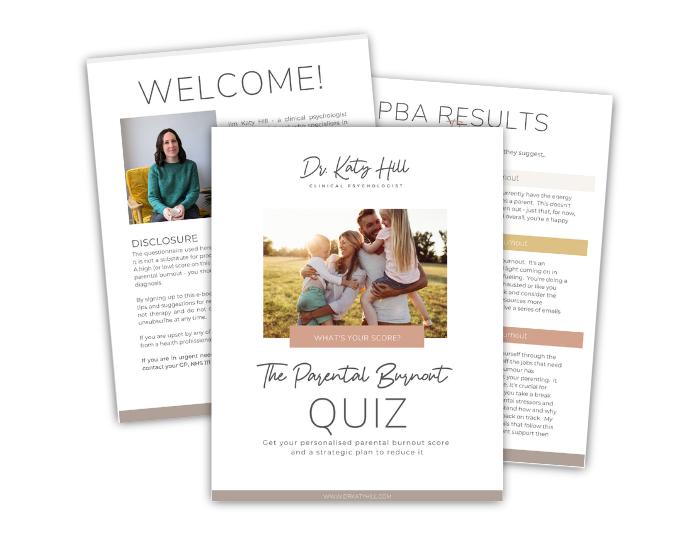
The Parental Burnout Quiz
Curious what your own parental burnout score is? Download the free assessment and get your score – plus expert tips on how to reduce it.
how parental perfectionism shows up
I think most parents don’t really understand what perfectionism looks like, they think it means looking or feeling ‘put together’.
I tested this out recently by putting a series of polls up my Instagram stories asking whether my followers thought they were perfectionistic about parenting. 55% answered ‘I think so’, 23% said ‘Not sure’ and 22% answered ‘Definitely not’.
On the next slide, I explained what perfectionism actually looks like and asked if that felt familiar, 9% said ‘Nope, still not me’ but 91% had a lightbulb moment and answered the option ‘Oh. Maybe I AM trying to be perfect’.
Here are a few signs it might be affecting you:
1. You’re constantly worrying, “Am I doing this right?”
You want to make thoughtful parenting decisions but perfectionism makes every choice feel high-stakes. Whether it’s screen time, school choices, or how you handled that meltdown at bedtime, you often feel unsure and anxious. It feels like making the wrong choice could have disastrous consequences.
2. You feel guilty. A lot
Even when you know logically that no one parents perfectly, you can’t shake the guilt over small mistakes or bad days. You blame yourself and can be quite critical of yourself, holding yourself to higher standards than you’d ever expect from a friend.
3. You compare yourself to others (and always come up short)
You scroll Instagram or talk to other parents and feel like you’re behind: not doing enough, not enjoying it enough, not calm enough. Perfectionism can make you hypervigilant to what everyone else is doing and, conversely, what they’re thinking about you.
4. You can’t rest unless everything is ‘done’
And since parenting is not a job that can ever be done, you’re rarely resting. You feel like you should always be doing something and when you’re not, you feel guilty.
5. You’re irritable, depleted, or emotionally distant
All this hypervigilance and pressure takes a lot of energy – the more pressure you put on yourself to ‘get it right’, the more depleted you feel which makes it even harder to be the parent you want to be – it’s hard to spend time with your kids in the calm, patient, fun way you’d like when you’re exhausted.
why this matters: parental perfectionism and burnout
Here’s the connection I want to gently underline: Parental perfectionism is one of the key risk factors for parental burnout.
When your inner dialogue is full of shoulds, shame, and pressure, it’s incredibly difficult to feel calm, connected, or resourced. And when perfectionism stops you from asking for help or setting boundaries, the load just keeps getting heavier.
Over time, that emotional strain can turn into burnout – a state of deep physical and emotional exhaustion, emotional distancing from your children, and a painful loss of joy in parenting.
If this sounds familiar, you’re not broken. And you’re not alone. You’re simply carrying too much on your own. I have written lots of great blogs about parental burnout and maybe the best place to start is with this one: ‘Parental Burnout: what it is, why you feel this way and how to feel better’.
there's another way
I’m not here to tell you to ‘just lower your standards’ – that advice often backfires. The truth is, many perfectionist parents value being intentional, attuned, and consistent. Those are beautiful traits.
What needs to change isn’t what you care about; it’s how rigidly you hold yourself to impossible expectations.
So how do you soften that grip, without letting go of what matters?
That’s exactly what we’ll explore next time, in Part 2: “Unpicking Parental Perfectionism: How to Soften Without Letting Go of What Matters.”
We’ll walk through compassionate, practical steps you can take to loosen perfectionism’s grip and parent in a way that feels more sustainable, spacious, and self-compassionate.
Be gentle with yourself
If any of this has resonated, I want you to know that ‘being too perfectionistic’ isn’t another stick to beat yourself with. You’re not doing anything wrong, you’re using a strategy that can be very helpful at times, but you’re probably using it too rigidly.
Your kids don’t need a perfect parent – they just need you. A you that accepts and models that it’s ok to be a normal, messy human and that it’s not perfection that matters but showing up again and again with love.
If you’d like to explore how therapy could help you soften these patterns, reconnect with your values, and build a more sustainable parenting life – I’d love to talk.